
How to Reduce Blood Pressure with Healthy Eating Tweaks
Among people with high blood pressure, only about half have their blood pressure under good control. Whether you have high blood pressure and hope to improve control to reduce the toll it takes on your health, or hope to delay or avoid development of high blood pressure, the good news is that changes in your eating habits can help.
Even better news: if you’re not up for a major overhaul of your diet, research has identified ways in which we can “tweak” eating habits with relatively small changes that can add up to make a difference for a healthier blood pressure and improve overall health at the same time. Tweaks that cut sodium are part of this, but let’s make sure we consider the big picture of how eating habits affect blood pressure.
What’s the big deal? According to the U.S. Centers for Disease Control and Prevention (CDC), high blood pressure makes you four times more likely to die from a stroke, and three times more likely to die from heart disease.
In the United States, about 1 in 3 adults – or about 2 in 3 age 60 and older — has high blood pressure. Another 1 in 3 has prehypertension, above-normal blood pressure between 120/80 mmHg and 139/89 mmHg, not high enough to classify as hypertension, but now recognized as high enough to increase risk of heart disease and stroke. Your blood pressure can be high for years without causing any symptoms, even though it is damaging your heart, blood vessels and kidneys.
Let’s consider three places you can look for ways you might tweak your current eating habits for healthy blood pressure….
Tweak #1 for Blood Pressure: Cut Sodium with Smart Swaps
You’ve probably heard the to-and-fro controversy about how much sodium in the diet is best. A big part of this confusion: different types of studies address the question, and each poses problems as researchers work at interpreting what they really show.
Years of controlled trials in which food is provided for people – meaning they don’t have to figure out how to choose and prepare food to keep sodium at a particular level – show reducing sodium consumption leads to lower blood pressure in most people.
♥ In the famous DASH-Sodium trial, for people with prehypertension or stage 1 hypertension (160/80-95 mm Hg and lower) consuming a typical U.S. diet, compared to 3300 mg sodium per day (a little less than the current average for U.S. adults), blood pressure dropped. Further reducing sodium to 1500 mg a day, blood pressure dropped a total of 7/4 mm Hg. Note that this was without any weight loss, which could lower blood pressure and make it hard to see the effects of cutting sodium. These people were not taking any blood pressure medications.
The advantage of these studies is ability to control sodium intake for accurate results. The disadvantage is that they can’t run long enough in a large number of people to evaluate changes in true endpoints, like heart attack or stroke.
♥ Studies that follow large groups of people for many years offer long-term perspective. However, measuring people’s sodium consumption – whether by questions about their diet or by one-time urine tests of sodium output – includes enough measurement error that there is “messiness” in the data. The other thing to consider when you hear about an observational study linking lower sodium consumption with no difference in cardiovascular events or even with more deaths is that this does not establish danger from low sodium intake. It can reflect factors like “reverse causation”, in which people with pre-existing illness have reduced sodium intake.
♥ Review of a wide range of studies led a panel of expert researchers to conclude evidence is strong in adults 30–80 years of age, with or without hypertension, that reducing sodium intake by about 1150 mg per day reduces blood pressure by 3–4/1–2 mm Hg. Blood pressure reduction occurs across gender, age and ethnic background. The panel concluded that evidence is more limited regarding specific health outcomes, but that reducing sodium intake by about 1000 mg a day reduces cardiovascular disease events by about 30%. Even if recommended sodium levels are not reached, reducing sodium by about 1000 mg a day reduces blood pressure.
In studies that used medication to reduce blood pressure by an average 3.6/2.4 mm Hg, this significantly reduced stroke and other cardiovascular events as well as deaths.
Since latest figures place U.S. adults’ average sodium consumption at 3592 mg a day, setting an initial goal of reducing current daily totals by 1000 mg a day makes sense as a target that will make a difference on its own, and perhaps pave the way for taste changes and new habits that can ultimately lead to further reductions in sodium.
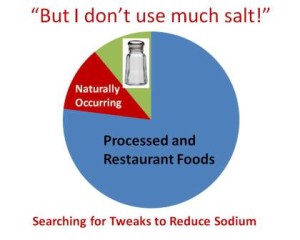
For most people, looking only at the salt shaker is looking in the wrong place. It’s estimated that for most Americans, 75 to 80 percent of our sodium comes from the foods we eat, rather than the salt we add to it at the table.
You’ve probably heard advice to cut back on the salt shaker for a healthier blood pressure. Sodium, which makes up 40% of salt, is the problem. Too much sodium leads to higher blood pressure by increasing the volume of blood that must be pumped through your blood vessels. Some studies suggest that consuming too much sodium may also affect blood vessel function, a problem reduced when sodium consumption decreases.
More than 40% of the sodium we eat comes from 10 basic food types: breads and rolls, cold cuts and cured meats (like bacon, ham and sausage), pizza, poultry (from types that are injected with salt water solution, as well as all the processed versions of poultry we choose), soups, sandwiches, cheese, pasta dishes, meat dishes and snacks.
That makes these foods a great place to focus. Find four swaps that each cut 250 mg of sodium, and you’ll achieve that target of cutting sodium by 1000 mg a day. In an upcoming Smart Bytes® post, we’ll look in more detail at examples of simple changes that can add up to cut sodium. Here are a few to start your thinking:
♥ Swap highly processed foods with added salt and sodium-based additives for less processed forms.
- Rice, couscous or other cooked grains: Instead of “flavored” mixes, skip the salty flavor packet – or save money by choosing the unflavored version — and add your own herbs, spices, garlic or other flavorings. Sodium drops from 500 to 1000 mg per cup (cooked) to essentially 0 mg.
♥ Switch the proportion of foods in your overall eating habits: more low-sodium options, smaller amounts of foods higher in sodium.
- Burgers on the menu? Stick to one burger (and thus one bun, which has more than double the sodium of the burger), adding some extra raw vegetables to your plate. The change drops at least 250 mg of sodium.
♥ Change out specific products for other brands or lower-sodium versions.
- Legumes like garbanzo beans and black beans offer so much nutritionally. Switch from 1/2 cup regular canned (390 mg sodium) to 1/2 cup canned with no added salt (10 mg sodium). Or at least drain and rinse the regular beans, and you’ll cut sodium by 156 mg.
What swaps and tweaks in each of these categories work for you? Please share in the comment box below, and come back for more ideas in an upcoming Smart Bytes®.
Tweak #2 for Blood Pressure: “DASH-ify” Your Eating Habits
The DASH diet was developed to test steps beyond limiting sodium that could reduce blood pressure. Blood pressure dropped in study participants by about 6/3 mm Hg. Among those with hypertension, the effect was even more powerful, reducing blood pressure by about 11/6 mm Hg.
The good news is that DASH helps people who need it most: blood pressure falls more in people with hypertension, and more in those who aren’t reaching recommended sodium targets than in those who get sodium down to 1500 mg a day.
So how do you DASH-ify your eating habits? Some people have focused on DASH to boost potassium, which seems to counter sodium’s blood pressure-raising effects. However, when researchers added supplements of potassium – even with magnesium, which is also increased in a DASH-style diet compared to typical U.S. eating habits – although elevated blood pressure improved, it did not drop to the extent seen with the same amount of potassium and magnesium delivered as part of whole foods in a healthy eating pattern.
DASH-style eating habits mean eating more whole grains, legumes (dried beans and peas), nuts and seeds. Together, all these plant foods boost consumption of potassium and magnesium, and provide heart-healthy nitrates (from dark leafy greens and beets), dietary fiber and natural plant compounds like polyphenols. Not only do these foods together seem to improve blood pressure more than potassium alone — research shows other heart-health benefits, and the potential to reduce cancer risk, too.
DASH-style eating habits don’t only boost these healthful foods. To avoid excess calories and weight gain from all the foods added, limit sweets and sugar-sweetened drinks – ideally to just a few small servings a week. It’s not yet clear, but some evidence suggests that high intake of added sugars might affect blood pressure and heart health directly, in addition to its effects on weight gain.
Don’t attempt this as a “diet” – something you go “on” and then “off”. Try out a variety of small tweaks you can make to your eating habits, and keep the ones that can become a good fit for you.
♥ Include at least 1 to 1 1/2 cups of vegetables and/or fruits at each meal. To do that without adding excess calories, keep portions of meat or poultry and grains or other starchy foods proportionately smaller.
♥ Swap grain product choices so that at least half are whole-grain options instead of refined grains, which are lower in nutrients and protective plant compounds.
♥ Including 2 to 3 servings of low-fat dairy products has been part of the DASH diets as tested to reduce blood pressure. The total DASH diet reduced blood pressure more than a diet only increased in vegetables and fruits. Since this may reflect effects of calcium, if you don’t use dairy products, non-dairy alternatives that are rich in calcium (like calcium-fortified soymilk) are good choices. Blood pressure-specific effects of either of these options aren’t clear.
♥ Behavior is most effectively changed when you focus on what you will do, rather than what you won’t. If you drink sugar-sweetened ice tea, soda or coffee beverages often, focus on drinking more water instead.
For more ideas of healthy swaps especially perfect for summer, check The Irony of the Summer Barbecue, from the archives!
Tweak #3 for Blood Pressure: Consider Cutting Some Calories

Even when DASH-style eating habits are combined with reduced sodium, for people who have excess unhealthy body fat, adding a calorie cut (and boosting physical activity) to allow some weight loss slashes blood pressure more effectively than DASH plus lower sodium alone. An expert panel concluded that strong evidence shows a 5% weight loss (9 pounds for someone who weighs 180) generally reduces blood pressure by about 3/2 mm Hg. This loss is enough to reduce need for blood pressure control medications, and even smaller losses can have some effect on blood pressure.
Don’t count on “eating healthy” to produce weight loss. Healthy choices help, but weight loss is not automatic.
♥ When lots of food is available, many people find they eat more whether or not they’re truly hungry. Set yourself up to allow the DASH-style boost in vegetables to fill you up on fewer calories.
♥ Just as you can accumulate several lower-sodium choices that add up to a total drop in sodium consumption that makes a difference, you can also make choices that add up to cut 500 calories a day, a recommended target for losing weight. A few small swaps that each reduce calories by 100 calories or so are all it takes.
♥ If non-hunger eating – eating in response to stress or boredom, for example – is driving your eating, address those habits. You can develop new ways to respond to those situations. You can also address the balance of Drainers vs. Fillers in your life to reduce how often you’re in the position of using food to deal with stress.
Bottom Line for Better Blood Pressure:
You can gradually tweak your eating habits, making swaps and adjustments that multi-task in reducing sodium and excess calories, while helping you include more of the foods linked with lower blood pressure.
You don’t have to do it all or make a “perfect” diet. By making a series of relatively small steps, evidence is good that you’ll create eating habits that fit your lifestyle and are likely more effective than focusing on major changes in just one target. The bonus? These same changes are likely to reduce your risk of cancer, too.
Learn more about high blood pressure from the National Heart Lung and Blood Institute (part of the National Institutes of Health) and the CDC website. NHLBI also offers a wallet card, where you can keep track of blood pressure readings and questions for your doctor.
For more on prehypertension, check the Harvard Health Blog (by Harvard Medical School) post on its link to risk of stroke. (March 14, 2014)
You can get more ideas on options for reducing your consumption of sodium from the American Heart Association’s Breaking Up with Excess Sodium, as well as extra help to zero in on The Salty Six.
For ideas on how you can set up your work and home environment to make the eating habit tweaks you target easier to accomplish, the latest book from Cornell’s Brian Wansink, PhD, called Slim by Design: Mindless Eating Solutions for Everyday Life, may be just what you’re seeking.
James P et al. 2014 Evidence-Based Guidelines for the Management of High Blood Pressure in Adults. Report from the Panel Members of the Eighth Joint National Committee (JNC8). JAMA. 2014; 311(5):507-520.
Nwankwo T et al. Hypertension among adults in the United States: National Health and Nutrition Examination Survey, 2011-2012. NCHS Data Brief. 2013 Oct; 133:1-8.
Sacks FM et al. blood pressure dropped. DASH-Sodium Collaborative Research Group. N Engl J Med. Jan 4 2001;344(1):3-10.
O’Donnell M et al. Urinary sodium and potassium excretion, mortality, and cardiovascular events. N Engl J Med 2014;371:612-623.
Cobb LK et al. Methodological Issues in Cohort Studies That Relate Sodium Intake to Cardiovascular Disease Outcomes: A Science Advisory From the American Heart Association. Circulation. 2014; 129: 1173-1186.
Davy BM et al. Sodium Intake and Blood Pressure: New Controversies, New Labels…New Guidelines? J Acad Nutr Diet. 2015; 115(2):200-204.
Eckel RH et al. 2013 AHA/ ACC Guideline on Lifestyle Management to Reduce Cardiovascular Risk. Circulation.Jun 24 2014;129(25 Suppl 2):S76-99.
Forman JP et al. Association between sodium intake and change in uric acid, urine albumin excretion, and the risk of developing hypertension. Circulation. 2012; 125:3108-3116.
Jablonski KL et al. Dietary sodium restriction reverses vascular endothelial dysfunction in middle-aged/older adults with moderately elevated systolic blood pressure. J Am Coll Cardiol. 2013; 61(3):335-43.
Blumenthal JA et al. Effects of the DASH diet alone and in combination with exercise and weight loss on blood pressure and cardiovascular biomarkers in men and women with high blood pressure: the ENCORE study. Arch Intern Med.2010; 170(2):126-135.
Jensen MD et al. 2013 AHA/ACC/TOS Guideline for the Management of Overweight and Obesity in Adults: A Report of the American College of Cardiology/American Heart Association Task Force on Practice Guidelines and The Obesity Society. Circulation. 2014;129(25 Suppl 2):S102-38.c
5 Comments
Leave a Comment
Published : July 1, 2015
Tagged: DASH diet, healthy diet, healthy eating, heart disease, heart health, high blood pressure, hypertension, metabolic syndrome, plant-based diet, potassium, salt, sodium
Meet the author/educator

Karen Collins
MS, RDN, CDN, FAND
I Take Nutrition Science From Daunting to Doable.™
As a registered dietitian nutritionist, one of the most frequent complaints I hear from people — including health professionals — is that they are overwhelmed by the volume of sometimes-conflicting nutrition information.
I believe that when you turn nutrition from daunting to doable, you can transform people's lives.
Accurately translating nutrition science takes training, time and practice. Dietitians have the essential training and knowledge, but there’s only so much time in a day. I delight in helping them conquer “nutrition overwhelm” so they can feel capable and confident as they help others thrive.
I'm a speaker, writer, and nutrition consultant ... and I welcome you to share or comment on posts as part of this community!
[…] Healthy Eating Tweaks for Lower Blood Pressure […]
Hi Karencollinsnutrition,
Thank you for the information. This will really helps. I appreciate and love this post!
Thanks for the positive feedback, Ellen. I’d love to hear how you use some of these ideas and which you find most helpful. Keep us posted!
[…] promote heart health. A previous Smart Bytes® painted the broad picture of different kinds of tweaks that can add up to promote a healthy blood […]
[…] can drop systolic blood pressure about 5 to 11 mm Hg. In a previous Smart Bytes®, we explored some simple swaps you can try to DASH-ify your eating […]