

Cutting Sodium: Doable Eating Habit Tweaks
Reducing the hefty sodium load that’s part of many people’s eating today can seem a confusing and daunting challenge. Average U.S. sodium intake at 3592 milligrams (mg) per day – not counting any salt added at the table — is well beyond the recommended cap of 2300-2400 mg. Reaching the target the American Heart Association identifies as “ideal” (no more than 1500 mg daily) would require major changes in all aspects of eating choices and preparation.
However, reducing sodium is not an all-or-nothing proposition.
Instead of focusing on a target that may feel out of reach, try finding a few doable tweaks in your usual choices. Just a few swaps can add up to reduce your current daily totals by 1000 mg a day. That’s a goal that research supports to make a difference in your health. Given the high sodium levels in many foods today, the tweaks may not be as hard to accumulate as you think.
With two out of three U.S. adults now at risk of heart disease, stroke and kidney disease because they have either hypertension or prehypertension, most of us can benefit from finding at least a few steps we can take to reduce sodium. Cutting sodium is not the only change in eating habits that can lower your blood pressure and promote heart health. A previous research review here painted the broad picture of different kinds of tweaks that can add up to promote a healthy blood pressure.
Evidence examined provided more depth on why a smart approach is to look for steps with multiple benefits. Aim for achievable changes in eating habits that reduce sodium AND help you create more plant-focused eating to boost health-promoting foods and allow you to feel full on fewer calories to help you reach and maintain a healthy weight.
Tweaking Strategy #1:
 Snip Sodium by Choosing Less Highly Processed Food
 Snip Sodium by Choosing Less Highly Processed Food
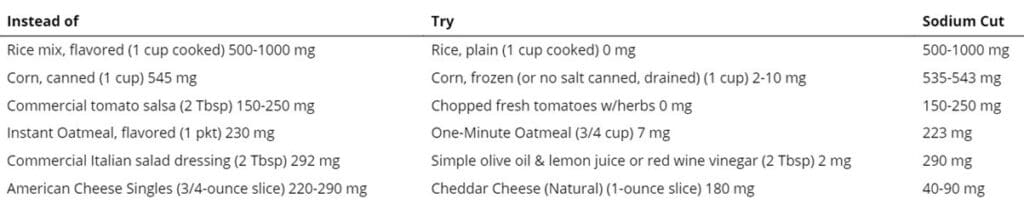
Let your inner detective loose: Search out highly processed foods with added salt and sodium-based additives that you eat on a regular basis, and try some more healthful options instead.
Tweaking Strategy #2:
Swap Your Usual for Brands and Product Options Lower in Sodium
 Swap Your Usual for Brands and Product Options Lower in Sodium
When I put out a call to my Registered Dietitian Nutritionist (RDN) colleagues asking for sodium-cutting steps they use themselves and with patients or clients, it’s clear this approach holds lots of potential.
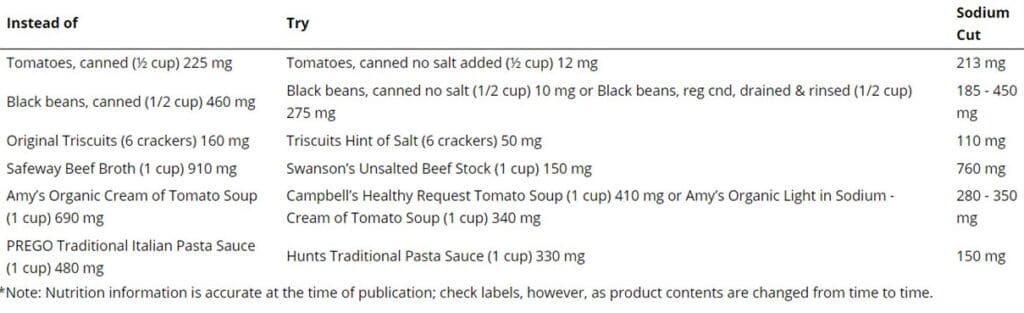
- Black beans, garbanzo beans (chickpeas), kidney beans and other legumes are such nutrient-rich sources of fiber and protein. Since using more beans is a health-promoting strategy, it’s worth considering lower-sodium options instead of the standard oh-so-convenient canned beans. Check the chart below to see how simple choices can reduce sodium dramatically. As another option, Melinda Hemmelgarn, MS, RD, suggests starting from scratch and cooking dry beans in big batches and freezing them in smaller portions. Sodium, ranging from 2 to 11 mg per half-cup cooked, can’t be beat.
- You may not think of ready-to-eat cereal as a source of sodium, but check labels. Some with healthful whole grain may still contain more sodium than you think. Jessica Corwin, MPH, RDN, a culinary nutritionist in West Michigan, notes that sodium in one-cup portions of Grape Nuts and Shredded Wheat differ by 500 mg. Of course, dense cereals like Grape Nuts and granola are generally meant for smaller portion sizes. Yet if it’s a food you eat nearly every day, swapping a higher-sodium cereal for Shredded Wheat or a similarly low-sodium option, could make a big difference.
Tweaking Strategy #3:
Switch Proportions of Foods
 Switch Proportions of Foods
Shifting which foods dominate in your eating habits – bigger portions of low-sodium foods, smaller amounts of foods higher in sodium – can be a great way to reduce sodium and improve the overall health boost you get at the same time. What’s more, you can do all this without necessarily “giving up” anything… simply allowing the less healthful foods a smaller role in your eating.
- In tacos, meatloaf and burgers, replace part of the meat with mushrooms. No, mushrooms are not a “meat substitute”, as they don’t provide as much of the protein, iron and certain other nutrients in meat. But as long as you include enough beans or nuts in the meal to provide additional protein, Kara Lydon, RD, LDN, RYT, shared research results showing that replacing part of the meat in such dishes with regular white mushrooms can actually increase overall flavor ratings. With a grant from the Mushroom Council, research at the Culinary Institute of America and University of California, Davis, showed that the flavor enhancement by mushrooms, which is especially strong when mushrooms are either seared or roasted first, seems to stem from the “umami” flavor they lend and an enhanced perception of salt due to the increased juiciness mushrooms add.
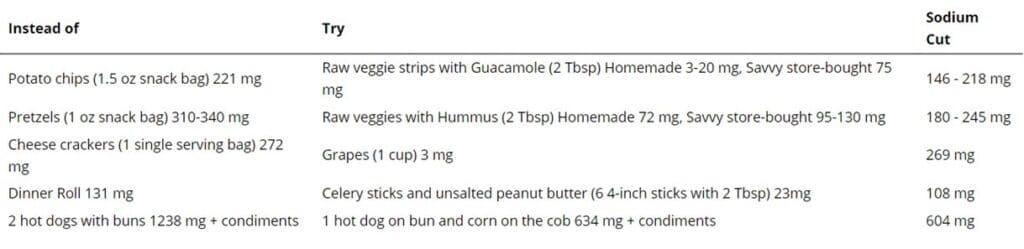
- Burgers, dogs or sausage on the menu? The chart below shows the sodium savings by sticking to one hot dog and filling up on vegetables instead. An even better choice is to choose meat that is not processed – in other words, a lean burger instead of a hot dog or sausage. Better still, from an overall health perspective, choose a lean poultry, fish or bean-based burger. The bun itself has more than double the sodium of a burger, so even with these healthier options, stick to one, and fill your plate with grilled or raw vegetables.
- Whole grains bring a wide range of nutrients, fiber and phytochemicals and are clearly part of a heart-healthy eating pattern. Rather than getting all your whole grains from bread, try using unsalted cooked grains and cereals as options, too, since the higher sodium in regular bread and rolls can add up. Colleen Luther, RDN, LD, CPT, says she has encouraged clients who overdo on bread to switch to open-face sandwiches (one slice of bread instead of two), or use romaine lettuce or other leafy greens to roll up turkey and other fillings, and stuff tomato or bell pepper halves with tuna salad and other such choices.
- Portion sizes are a good starting point for many foods. If your portions of snack foods like the crackers and chips in the charts above and below are larger than what’s listed, the sodium load you’re currently getting is larger, and the sodium savings you get by changing habits becomes even more significant.
Bonus Sodium Tweaks:
Cut the Salt, Not the Flavor
For most Americans, 75 to 80 percent of sodium consumed comes from the foods we eat, rather than the salt we add to it at the table. However, especially if you’re among those who rely on salt to enhance the flavor of your food, try some other options. See how delicious food can be when flavored in other ways.
- Just a touch of salt can round out flavor, suggests Lauren Swann, MS, RD, LDN. But, she emphasizes, that doesn’t mean you have to rely on it to do all the heavy lifting for flavor. She suggests balsamic vinegar, lemon or lime juice with strong vegetable like spinach, and mushroom powder for a savory umami taste. Lauren also recommends some of the McCormick Perfect Pinch Seasoning Blends, noting the Italian isn’t labeled salt-free but is, and the Mexican isn’t terribly high in sodium (50 mg per ¼ teaspoon). [Lauren notes that she has not professional tie to these products.] Other top choices for her to keep food delicious without loading up on salt are cumin, garlic and onion powder, black pepper and cilantro.
- Another flavoring tip comes from my culinary-savvy colleague, Anne Danahy, MS, RD. She suggests, “When making soups, stews or any dish that uses sautéed vegetables, really caramelize your vegetables to bring out natural sugars and flavors – especially onions, carrots, celery.” Anne also recommends loading up on mushrooms – especially porcini and other dried varieties – to add umami flavor. For a burst of flavor, add a sprinkle of fresh green onion, chopped basil, cilantro, parsley, sweet or hot pepper to a finished dish for a boost of flavor and texture just before serving.
*My sincere thanks to Kristine James, dietetics student at Kansas State University, whose help in pulling together nutritional data for this post has been invaluable.
** Sincere thanks also to my RD/RDN colleagues who so kindly shared favorite tips and tweaks they use in working with patients and clients on heart-healthy eating.
Working with a registered dietitian nutritionist really can make the goal of creating healthier eating habits that fit your lifestyle and tastes much easier than going it alone. If you’d like help finding one in your area, check the Academy of Nutrition and Dietetics website, where you can enter your zip code and get a list of RDs/RDNs in your area.
Bottom Line:
Since latest figures place U.S. adults’ average sodium consumption at 3592 mg a day, reducing your current daily total by 1000 mg a day is an achievable goal that makes sense.
That’s a target that will make a difference on its own, and perhaps pave the way for taste changes and new habits that can ultimately lead to further reductions in sodium. The sodium tweaks that most effectively cut sodium for each of us vary depending on our individual starting point habits. Using the framework described here, consider the kinds of foods that are most concentrated in sodium that are part of your regular eating choices. Replacing a food that is very high in sodium that you eat only once a month won’t have as much impact as changes related to a moderately high sodium food that you eat daily. It may take some experimentation to find the flavoring and swaps that work best for you. Don’t let that scare you off. Consider it good news: this is a goal that truly does get easier with practice.
If you find this info helpful, please share it on Facebook, Twitter or through an email to a friend or colleague.
If you aren’t already receiving my research updates via email, sign up so you don’t miss what’s next. Click here, and you’ll also get a bonus tool to support healthy eating.
4 Comments
Leave a Comment
Published : September 7, 2015
Tagged: healthy diet, healthy eating, heart health, high blood pressure, hypertension, sodium
Meet the author/educator

Karen Collins
MS, RDN, CDN, FAND
I Take Nutrition Science From Daunting to Doable.™
As a registered dietitian nutritionist, one of the most frequent complaints I hear from people — including health professionals — is that they are overwhelmed by the volume of sometimes-conflicting nutrition information.
I believe that when you turn nutrition from daunting to doable, you can transform people's lives.
Accurately translating nutrition science takes training, time and practice. Dietitians have the essential training and knowledge, but there’s only so much time in a day. I delight in helping them conquer “nutrition overwhelm” so they can feel capable and confident as they help others thrive.
I'm a speaker, writer, and nutrition consultant ... and I welcome you to share or comment on posts as part of this community!
I’m glad that there are resources like this. I’m post heart transplant and have been on this low sodium journey for a few years now. I firmly believe you can lose salt without the taste. I have all my tips and recipes on my blog. http://hackingsalt.com
Thanks, Christopher! I love your positive attitude. Bravo for finding ways to make healthful eating enjoyable!
[…] your salt shaker and focus on swapping out your most frequent processed food choices. With a few doable tweaks, you can reach that target of going 1000 mg […]
[…] Common ultra-processed foods account for most of today’s sodium load. So look beyond your saltshaker. The good news is that you can still enjoy tasty, convenient food and achieve meaningful reductions with some simple sodium-cutting tweaks for healthy eating. […]