

Soy Food Choices and Cancer: Translating Research to Answer 3 Practical Questions
I shared the “long and winding road” we’ve walked in research on soy and breast cancer risk in a previous research review on this topic. – It’s one of the most frequently asked questions when I’m speaking about breast cancer. Once you get the general idea that moderate consumption of soy foods appears quite safe, even for women who have had estrogen receptor-positive (ER+) breast cancer, a whole new batch of questions arises.
What is moderate consumption of soy foods? Where do the cereals, breads, and bars with added soy protein fit into this picture?
Soy Food Choices: What is Moderate Consumption?
Large population studies examining whether consumption of soy foods is linked to increased or decreased breast cancer risk or recurrence start by asking participants how often they eat tofu, tempeh, edamame, miso and a variety of other soy foods. Then the researchers group these foods together to indicate total consumption of soy foods.
Most studies divide participants into four or five groups based on their soy food consumption. Breast cancer incidence, recurrence or survival of the group who consume the most is compared to that of those who consume the least.
The amount identified as “high” or “low” consumption of soy foods depends on the particular group of people studied.
- High consumption in Asian population studies is often substantially higher than “high” consumption in the U.S. And consumption varies among different Asian countries. In U.S. studies, those ranked as “high” soy consumers generally eat no more than what is simply average in Asia (and often less).
- High consumption in U.S. studies can vary with who’s participating, since dietary patterns differ. For example, high soy food consumption in a group that includes a lot of Seventh Day Adventists (who are often vegetarian) or Asian Americans may be quite different than amounts that are “high” in a group of mainly older Midwestern women.
- Low soy food consumption in Asia may be a few servings per week, whereas in the U.S. it is always “none”, since there are many Americans who do not eat any whole soy foods at all.
And just as we see with other foods, when some is good, that doesn’t mean that more is necessarily better. In the Shanghai Breast Cancer Survival Study, for example, consuming more soy was linked to decreased risk of death and recurrence. But as consumption increased more and more, the effect plateaued. In that study, the plateau effect occurred at 11 grams of soy protein and 40 milligrams of soy isoflavones (less than two servings per day). More wasn’t linked to risk, but it also showed no added health benefits.
In order to be able to talk about the big picture from research on soy foods and their links to health, a generally recognized definition of moderate consumption of soy foods is one to two servings per day. This is the average consumption of soy foods in the Asian populations most studied regarding soy. In Asian populations, high consumption generally refers to about two to three servings per day (which may provide 50 to 100 mg isoflavones).
What Is a Serving of Soy Foods?
The portion size of a soy food that is considered a standard serving is based on amounts with similar protein and isoflavone phytochemical content. On average, one serving contains about 7 grams of protein and 25 milligrams (mg) isoflavones, but all are not precisely the same.
One serving is considered: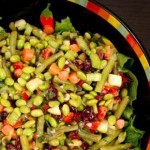
- ½ cup tofu (about 4 ounces)
- ½ cup tempeh (3 ounces)
- ½ cup edamame
- ½ cup cooked or canned mature soybeans
- 1 cup soymilk
- 1 cup soy yogurt
- 1 oz. soynuts (about ¼ cup)
- 1 Tbsp. miso
What about Soy in Non-Soy Foods?
Besides these soy foods, part of the traditional Asian diet for generations, processed forms of soy are added to an increasing number of foods that you don’t think of as soy foods. Soy protein concentrate (which can be produced in two different ways that result in very different levels of isoflavone content), soy protein isolate and soy fiber are added to bread, bars and cereal. They may be added to improve texture or moistness, or as a way to boost the fiber or protein content. And, of course, the freezer aisle is full of vegetarian burgers, “crumbles” (to replace ground beef) and nuggets made from soy protein concentrate or textured vegetable protein (TVP).
Since isoflavone content is not posted on food labels, and total protein listed does not distinguish soy protein from other sources of protein, I’ve been asked many times whether all these soy-amended foods could add up to levels of isoflavones beyond what Asian intake has established as safe.
I’ve contacted food companies that make many of these foods, and most do not have any analysis of the isoflavone content of their products with added soy protein or soy fiber. Most could give me the amount of the protein per serving that came from soy, however. Based on analysis conducted for research on isoflavones, and the federal USDA database listing of isoflavone content of isolated soy components, here’s what I’ve calculated as a rough estimate of what we get from these foods:
♦ Veggie burgers, which contain 10 to 15 grams of protein (not all of which comes from soy ingredients), from 1 to 10 mg isoflavones per patty. (That’s about 4-40 percent of a soy food serving.)
♦ Cereal with added soy protein concentrate that brings total protein to about 9 grams per serving (of which one-half to two-thirds may be soy), may contain 6 to 9 mg isoflavones per standard 1-cup serving of cereal (or less, in some cases).
♦ Bread with soy flour or soy fiber is listed in database tables with isoflavone content that translates to about 0.2 to 0.4 mg isoflavones per one-ounce slice of bread.
♦ Donuts may be made with soy flour as one of the ingredients, but each donut ends up containing 0 to 2 mg isoflavones. (The isoflavones are the least of the health concerns about overdoing on these donuts.)
♦ Nutrition bars made with soy protein isolate and/or soy flour average about 7 to 10 mg isoflavones per bar (though can range from 3 to 18 mg, depending on ingredients and size of the bar).
♦ Pasta with added protein actually most often does not get its protein boost from soy, but from other legumes, such as lentils or chickpeas, possibly along with flaxseed or egg white. Soy pasta is available in specialty stores, but the higher-protein pasta you see in the grocery store probably contains only a trace of isoflavones.
It’s possible that if you ate a diet based entirely on soy-enriched foods and drinks, your isoflavone consumption could go beyond that level seen among “high” soy consumers in Asia that we use as a benchmark of safety. But that sort of diet would be unhealthy for many reasons.
There’s no basis for concern that use of a few of these foods as part of a balanced eating pattern is going to add up to extreme isoflavone consumption. The bigger question concerns the other ingredients in the food and how the food works for or against quality of your overall diet.
- Is it high in added sugars, refined grains, sodium, or unhealthy fats?
- Is it replacing vegetables or fruits? Or is it a food that accompanies vegetables or fruits?
- Is this a food with an undeserved “health halo” based on protein content? Or it is helping people avoid excess red meat, or get the protein they need within other dietary limits?
Bottom Line on Soy Food Choices
Whole soy foods are a package with many nutrients, and not all effects on health necessarily come from their isoflavone compounds. Soy foods are not a necessity for a healthy diet. But moderate consumption of 1 or 2 servings a day can help build a healthy diet. And some benefit may even come from other food choices of people who eat more soy – perhaps they eat more vegetables or get more fiber, for example.
Switch your focus from considering soy foods solely as a source of isoflavones. Look at whole soy foods – like tofu, tempeh, and edamame – for what they offer as a way to cut back on red meat and eat a more plant-focused, overall healthy diet. Foods with isolated soy protein or fiber can also contribute to a healthy diet, and there’s no need to fear them nor to award them health halos.
If you’d like to learn more about soy and cancer, or how you might use soy foods, check the section on soy in the American Institute for Cancer Research (AICR) website section of Foods that Fight Cancer.
For more information about isoflavone content of specific foods, you can check the USDA Database for the Isoflavone Content of Selected Foods (version 2.1, November 2015 update).
Messina M, Nagata C, Wu AH. Estimated Asian adult soy protein and isoflavone intakes. Nutr Cancer. 2006;55(1):1-12.
Shu, XO, et al. Soy food intake and breast cancer survival. JAMA , 2009. 302(22): 2437-43.
Umphress, ST et al. Isoflavone content of foods with soy additives. Journal of Food Composition and Analysis, 18 (2005) 533–550.
U.S. Department of Agriculture, Agricultural Research Service. 2015. USDA Database for the Isoflavone Content of Selected Foods, Release 2.1.
Food company data from direct personal communications.
soy foods (top image) — Brent Hofacker © 123rf.com – 90368927
1 Comment
Leave a Comment
Published : February 6, 2013 | Last Updated: December 13, 2016
Tagged: breast cancer, cancer prevention, cancer risk, cancer survivors, healthy diet, healthy eating, isoflavones, phytoestrogens, plant-based diet, reducing cancer risk, Soy, soy foods
Meet the author/educator

Karen Collins
MS, RDN, CDN, FAND
I Take Nutrition Science From Daunting to Doable.™
As a registered dietitian nutritionist, one of the most frequent complaints I hear from people — including health professionals — is that they are overwhelmed by the volume of sometimes-conflicting nutrition information.
I believe that when you turn nutrition from daunting to doable, you can transform people's lives.
Accurately translating nutrition science takes training, time and practice. Dietitians have the essential training and knowledge, but there’s only so much time in a day. I delight in helping them conquer “nutrition overwhelm” so they can feel capable and confident as they help others thrive.
I'm a speaker, writer, and nutrition consultant ... and I welcome you to share or comment on posts as part of this community!
[…] soy intake, including consumption from an early age. Research now suggests this is the case for soy’s potential to reduce risk of breast cancer, and perhaps it’s true for prostate cancer, […]