
How to Reduce Prostate Cancer Risk? What Research Shows Now
Prostate cancer is the most commonly occurring cancer in men,

Feel information overload trying to make sense of ways to reduce prostate cancer risk?
so health-conscious guys take note of news stories about healthy eating and lifestyle choices to reduce prostate cancer risk. How can you weed through all the suggestions out there?
In Smart Bytes®Part 1 on this topic, we looked at where research stands on tomatoes and lycopene, selenium and green tea. Here we’ll look at current evidence on more choices. Read on and share with the men in your life.
Soy – Not So Simple
Prostate cancer is much less common in countries like Japan where people eat soy often than in the U.S. Research suggests that soy, probably acting through compounds called isoflavones, especially genistein and daidzein, might be protective. In cell and animal studies, these isoflavones slow cancer cell growth, increase self-destruction of abnormal cells and decrease tumor formation. Soy and its phytochemicals could prevent cancer development by reducing inflammation and by changing cell signaling to increase the body’s antioxidant systems and inhibit activation of proteins that promote cell growth.
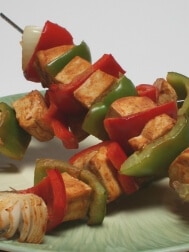
Baked Tofu Kabobs from AICR
Initial human trials showed that soy could decrease prostate-specific antigen (PSA) levels, a marker that may indicate development of prostate cancer or other prostate conditions. The next step, testing whether soy could actually decrease risk, recurrence or mortality from prostate cancer in men is where things have unraveled. An interim analysis of one randomized controlled trial, published this summer in the medical journal JAMA, found no effects in a group of prostate cancer survivors. Especially because it followed on the heels of another study with no effects seen, this brought an early end to a long-running study that had been conceived in hopes of bringing exciting findings for men’s health.
This most recent trial was conducted among men at seven US centers who had surgical removal of their prostate because of prostate cancer and were at high risk of recurrence. Within four months of surgery, they began daily use of a beverage powder that contained either 20 grams of soy protein isolate or a milk protein placebo, and continued using the product for up to two years. Researchers tested PSA levels every two months. Overall, PSA rose high enough to indicate “biochemical recurrence” in 28.3% of participants. There was no difference between the men taking soy protein isolate and those taking placebo.
Earlier, another randomized trial of soy protein supplements found them of no value as a way to reduce risk of prostate cancer in men who had not yet developed it but were at high risk. This trial was conducted in 12 Canadian centers among men who had biopsies indicating cells known as HGPIN in an early stage in the process leading toward development of invasive prostate cancer. In this double-blind trial, men consumed either daily soy (40 grams), vitamin E (800 IU) and selenium (200 mcg) or placebo for three years. Regular follow-up biopsies watched for development of prostate cancer. Invasive prostate cancer developed in 26.4% of patients, with no difference between those given the nutritional supplement or placebo. Among men who developed cancer, there was also no difference in Gleason score, a marker of the aggressiveness of the cancer.
What this means and what it doesn’t:
- These trials showing no effect used soy protein supplements. They do not represent the effects of whole soy foods, such as tofu, edamame, soy nuts and soymilk. Highest consumption of soy foods was linked to about 30 percent lower risk of prostate cancer compared to lowest consumption in an analysis pulling together results of multiple observational studies. On the other hand, these observational studies don’t prove cause-and-effect; other aspects of diet or lifestyle of the high soy consumers might be the true protectors.
- Perhaps the prostate cancer protection seen in observational studies is because of long-term soy intake, including consumption from an early age. Research now suggests this is the case for soy’s potential to reduce risk of breast cancer, and perhaps it’s true for prostate cancer, too.
- Soy also may affect cancer risk in some people more than others, due to differences in genetics and gut bacteria that metabolize soy compounds into their active form.
- More is not necessarily better. In Asia, where prostate incidence is so much lower than in Western populations, average consumption of soy foods is one to two servings per day. From a health perspective, that’s what we mean when we refer to moderate soy consumption. That would supply about 7 to 15 grams of soy protein and 25 to 50 mg of isoflavones. Reportedly, up to 10 percent in Asian populations consume as much as 25 grams of soy protein and 100 mg isoflavones. This level poses no risk, but the point is that the whole population shows lower prostate cancer risk, so there’s no reason to expect that the levels of soy protein provided as supplements in these studies are needed as part of a healthy diet.
- Not only might the effect of whole soy foods eaten as part of a long-term diet be different than that of isolated soy protein supplements taken for a few years late in life, the effects might also depend on synergy with other foods. Research is in progress looking at how soy and tomatoes might interact, for example.
Vitamin E – Evidence is Clear 
Initially, scientists thought vitamin E supplements might reduce risk of prostate cancer, but controlled studies dashed those hopes. In the SELECT trial, more than 35,000 men were randomly assigned to either vitamin E (400 IU per day), selenium (200 mcg per day), both, or placebo only. Neither supplement, alone or together, led to any reduction in prostate cancer risk. SELECT was ended early, because even by mid-study, analysis clearly showed that prostate cancer risk was not reduced.
Researchers continued to follow the men, since longer-term effects are possible. Beginning at about the third year of supplementation, men taking vitamin E alone began to show hints of greater risk. Updated analysis published in 2011 showed that at about seven years (5.5 years on supplements and 1.5 years of follow-up), vitamin E alone led to a 17 percent greater risk of prostate cancer compared to placebo. This is a statistically significant effect not likely to be due to chance. Men taking vitamin E and selenium were also more likely to develop prostate cancer, but the increased risk was smaller and statistical analysis said could be due to chance.
We now have enough data to draw several sound conclusions about vitamin E supplements:
- No clinical trials show a benefit from taking vitamin E to reduce the risk of prostate cancer. Even in the men in SELECT who took both vitamin E and selenium, although prostate cancer risk may not have truly increased, it clearly was not reduced.
- The 400 IU vitamin E dose was chosen to repeat the doses being discussed at the time for potential to decrease risk of heart disease. However, research now shows that vitamin E supplements do not reduce risk of heart disease. The American Heart Association specifically states that vitamin E is not protective, and people are advised against taking supplements.
- Could foods rich in vitamin E be protective? The dose of vitamin E used in SELECT (400 IU/day) is far higher than what a healthy diet provides without supplements or fortified foods. More and more research demonstrates a “U-shaped response curve” where very low or very high blood levels of a nutrient are harmful but more moderate levels are beneficial. What’s more, vitamin E in foods comes in multiple different forms, and it could be that the combination of forms working together with other nutrients is protective. We have only limited data supporting a role for vitamin E in food, but it is possible.
Protection without Pills or Powders
More Moving, Less Sitting 
Over 30 studies now link regular physical activity with a modest decrease in prostate cancer risk, mainly the advanced and aggressive forms that are most deadly. In analysis of a national survey called NHANES, after statistically adjusting for a variety of risk factors, each additional hour of sitting time was linked to a 16 percent increase risk of an elevated PSA, and each additional hour of even light activity was linked with an 18 percent lower risk of elevated PSA.
For insights, I turned to Kate Wolin, ScD, FACSM, Associate Professor in the Stritch School of Medicine at Loyola University, and lead author of a review paper on the subject. Her bottom line: “While the magnitude of risk reduction offered by exercise is not clinically large, exercise remains an important strategy for men concerned about prostate cancer risk.”
- Not only because exercise appears to reduce risk of aggressive prostate cancer, but also because many men diagnosed with prostate cancer die not from their cancer, but from comorbidities like heart disease. Physical activity offers multiple heart-protective benefits.
- Clearly an area that needs more research, Dr. Wolin notes a few limited studies suggesting that benefits of exercise for prostate cancer risk reduction might only come from vigorous exercise. However, those studies did find that non-vigorous activity was important for reducing risk of all-cause mortality in men diagnosed with prostate cancer.
There is really so much evidence now, Dr. Wolin emphasizes, “There are global benefits of physical activity across chronic disease outcomes!”
An Overall Plant-Focused Eating Pattern
Rather than any single food or nutrient, looking at a basic healthy eating pattern may be more important to help lower risk of prostate cancer. Among men in a large cohort study who had a history of PSA testing, those whose overall eating patterns most closely reflected U.S. dietary guidelines showed a seven or eight percent lower risk of prostate cancer when compared to men whose diets earned lowest scores. This suggests a modest effect, but its “statistical significance” means it is unlikely to be simply a matter of chance.
Another study, which assigned points for how closely people’s diets met the American Institute for Cancer Research (AICR) recommendations to reduce cancer risk, found highest scores linked with 16 percent lower risk of all cancer among thousands of men in a European study called EPIC, but found no link between scores and risk of prostate cancer. This is challenging to interpret, because scores gave equal weight to all the recommendations. It may be that risk of different cancers varies in the relative importance of particular eating and lifestyle choices. Prostate cancer poses special difficulties, because of the different forms seen. For example, overweight and obesity do not appear linked to overall risk of prostate cancer, but they do increase risk of the most dangerous high-grade prostate cancer.
Are omega-3 fats relevant to prostate cancer?
Meeting recommendations for fish or omega-3 fat consumption seems likely to be protective against prostate cancer, or perhaps at least against aggressive and fatal forms. Many questions need to be resolved about whether this may be more important for some men than others, what amount is optimal, and whether all omega-3 fats show equal effects or if types found in naturally high-fat fish are different than the ALA found in plant foods like walnuts, flaxseed and canola oil. In mice, walnuts (comparable in amount to two ounces a day for humans) reduced the number and growth rate of prostate cancers, which poses interesting potential to check in human studies.
Bottom line: We still have much to learn about how men can reduce their risk of prostate cancer. Supplements seem unlikely to be the key for most. Rather than counting on any one strategy, the smart choice seems to be focusing on healthy plant-focused eating habits, regular physical activity and reaching and maintaining a healthy weight. We know those steps reduce risk of cancer overall and promote heart health; hopefully prostate health may benefit, too, over the long haul.
Sign up by RSS feed or email to make sure you don’t miss the next Smart Bytes®!
Resources
If you want to read more about the SELECT trial of selenium and vitamin E supplements, check this fact sheet from the National Cancer Institute (NCI), Questions and Answers: Selenium and Vitamin E Cancer Prevention Trial (SELECT).
For help making physical activity a regular part of your lifestyle, check Start Where You Are and for the next step, Keep It Up, free brochures from the American Institute for Cancer Research (AICR).
References
Bosland MC, Kato I, Zeleniuch-Jacquotte A, et al. Effect of soy protein isolate supplementation on biochemical recurrence of prostate cancer after radical prostatectomy: a randomized trial. JAMA. 2013 Jul 10;310(2):170-8.
Fleshner NE, Kapusta L, Donnelly B, et al. Progression from high-grade prostatic intraepithelial neoplasia to cancer: a randomized trial of combination vitamin-E, soy, and selenium. J Clin Oncol. 2011 Jun 10;29(17):2386-2390.
Hwang, Y.W., et al. Soy food consumption and risk of prostate cancer: a meta-analysis of observational studies. Nutr Cancer. 2009;61(5): 598-606.
Messina M, Nagata C, Wu AH. Estimated Asian adult soy protein and isoflavone intakes. Nutr Cancer. 2006;55(1):1-12.
Lippman SM, Klein EA, Goodman PJ, et al. Effect of selenium and vitamin E on risk of prostate cancer and other cancers. JAMA 2009; 301(1):39-51.
Klein EA, Thompson IM, Tangen CM, et al. Vitamin E and the Risk of Prostate Cancer: Results of The Selenium and Vitamin E Cancer Prevention Trial (SELECT). JAMA 2011; 306(14): 1549-1556.
Bjelakovic G, Nikolova D, Gluud C. Meta-regression analyses, meta-analyses, and trial sequential analyses of the effects of supplementation with Beta-carotene, vitamin a, and vitamin e singly or in different combinations on all-cause mortality: do we have evidence for lack of harm? PLoS One. 2013 Sep 6;8(9):e74558.
AHA Science Advisory: Antioxidant Vitamin Supplements and Cardiovascular Disease. Circulation. 2004; 110: 637-641.
Mozaffarian D, Appel LJ, Van Horn L. Components of a Cardioprotective Diet: New Insights. Circulation. 2011; 123: 2870-2891.
Loprinzi PD, Kohli M. Effect of physical activity and sedentary behavior on serum prostate-specific antigen concentrations: results from the National Health and Nutrition Examination Survey (NHANES), 2003-2006. Mayo Clin Proc. 2013 Jan;88(1):11-21.
Wolin KY, Stoll C. Physical activity and urologic cancers. Urol Oncol. 2012 Sep;30(5):729-734.
Bosire C, Stampfer MJ, Subar AF, et al. Index-based dietary patterns and the risk of prostate cancer in the NIH-AARP diet and health study. Am J Epidemiol. 2013 Mar 15;177(6):504-513.
Romaguera D, Vergnaud AC, Peeters PH, et al. Is concordance with World Cancer Research Fund/American Institute for Cancer Research guidelines for cancer prevention related to subsequent risk of cancer? Results from the EPIC study. Am J Clin Nutr. 2012 Jul;96(1):150-163.
2 Comments
Leave a Comment
Published : September 19, 2013 | Last Updated: September 20, 2013
Tagged: antioxidants, cancer prevention, cancer risk, healthy eating, Kate Wolin, physical activity, plant-based diet, Prostate cancer risk, reducing cancer risk, Soy, vitamin E
Meet the author/educator

Karen Collins
MS, RDN, CDN, FAND
I Take Nutrition Science From Daunting to Doable.™
As a registered dietitian nutritionist, one of the most frequent complaints I hear from people — including health professionals — is that they are overwhelmed by the volume of sometimes-conflicting nutrition information.
I believe that when you turn nutrition from daunting to doable, you can transform people's lives.
Accurately translating nutrition science takes training, time and practice. Dietitians have the essential training and knowledge, but there’s only so much time in a day. I delight in helping them conquer “nutrition overwhelm” so they can feel capable and confident as they help others thrive.
I'm a speaker, writer, and nutrition consultant ... and I welcome you to share or comment on posts as part of this community!
Karen! Great article. Thanks for translating the research. Also, thanks for pointing out the soy not needing to be high and that supplements do not work. I found it interesting that how soy in metabolized in the gut can effect the benefit from it. Very informative on an important topic.
Thanks, Teresa. It really is fascinating, isn’t it, how we seem to be getting to the same point in so many places that pulling out individual nutrients and compounds and providing them in extra high amounts does not provide the same protection seen in an overall eating pattern of healthy foods? It will be terrific as years go by if research does find some people who need and are helped by higher amounts of individual compounds, but for general health protection, it does seem overall food choices are where we should place our energy.
And I agree with you, the world of the microbiota — healthy gut bacteria — and what it can do is likely amazing. And we’re just beginning to get a peek in the door on that!