Circadian Rhythms and Health: Can biological clocks go out of sync? Why it matters, What to do
Headlines abound about circadian rhythms going out of sync, with “must do” steps for meal timing, fasting, and sleeping to avoid problems with misalignment of biological clocks. Research ties circadian rhythms to heart health, blood sugar, and body weight. But what is purely theoretical so far, and what actions (if any) could be worth taking?
You’ll find insights here from Frank Scheer, PhD, a leader in this research. Dr. Scheer is Director of the Medical Chronobiology Program at Brigham and Women’s Hospital in Boston, MA, and Associate Professor of Medicine at Harvard Medical School. I was thrilled to have the chance to sit and talk with Dr. Scheer about this fascinating research.
I hope these notes from our conversation help you set commonsense priorities for how current findings fit with the other choices you make for a healthy lifestyle.

I’m grateful to Dr. Frank Scheer, a leading researcher on circadian rhythms, for spending time sharing his insights with me.
Can Circadian Clocks Go Out of Sync? 
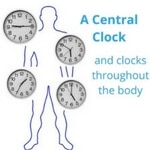
The circadian system is composed of a master clock and a whole series of clocks throughout the body that work together to help you function and stay healthy throughout the day. The central (master) clock is in the suprachiasmatic nucleus, located in the hypothalamus of the brain. However, virtually every cell in the body has the “molecular machinery” to drive a 24-hour rhythm, including in the heart, liver and even skin cells.
Circadian misalignment is one term that can apply to several different conditions:
- Your central clock does not line up with the light/dark cycle (out of alignment with the environment).
- Your central clock does not line up with when you go to sleep and wake up, or with when you eat and fast (out of alignment with your behavior).
- One body clock does not line up with other body clocks (for example your central clock is out of alignment with your liver, or your liver with your heart).
Who is Vulnerable to Circadian Misalignment?

These are examples of situations that could put people at risk of circadian rhythms going out of sync:
- Staying up late or sleeping near lights and electronics turned on
- Traveling to different time zones
- Working the night shift
- Eating late at night when the body is not in the mode to process food most efficiently and use it for fuel
- Developing “social jet lag” by changing schedules during the week (for example, different times for sleeping, getting up and eating during the week compared to weekends)
How Does Circadian Misalignment Affect Health?

Inflammation
Chronic, low-grade inflammation can lay groundwork for development of heart disease, cancer and other diseases. Researchers are studying the effects of circadian misalignment in this mix. For example, a randomized controlled study, including Dr. Christopher Morris as first author and Dr. Scheer as senior author, monitored 14 adults during eight days of simulated day shift work (circadian alignment condition) compared to four days of simulated night shift work (circadian misalignment condition) with a 12-hour flip of the sleep/wake, fasting/feeding, and dark/light cycles. All four markers of inflammation tested increased during circadian misalignment.
- The study controlled living conditions to remove differences in eating habits, physical activity and other aspects of lifestyle as possible explanations for the effects seen.
- Reduced total amount of sleep can be a problem with shift work, but in this study, it did not account for differences in inflammatory markers, showing that the effects of circadian misalignment are beyond the effects of reduced sleep.
Blood Pressure
The same trial with rotating 8-day periods of circadian alignment (simulated day shift) and misalignment also demonstrated effects on blood pressure. During circadian misalignment, average 24-hour systolic blood pressure was 3.0 mm Hg higher, and diastolic blood pressure was 1.5 mm Hg higher than during circadian alignment.
- During circadian misalignment, the dip in blood pressure that normally occurs during night sleep was especially awry, as this dip was 21% smaller than the night dip during the simulated day shift. Some evidence suggests that blood pressure during night sleep is an even better predictor of heart risk than daytime blood pressure.
- To put this blood pressure difference in context, the rise in blood pressure during the night shift condition in this study was comparable to the rise in blood pressure in the original DASH-Sodium trial between people consuming 3500 mg of sodium instead of the recommended 2300-2400 mg of sodium per day.
Blood Sugar and Diabetes
It’s not only misalignment of sleep with body clocks that poses health concerns. Work by Dr. Scheer and others shows that meal timing can affect blood sugar and insulin levels.
“In people who don’t have diabetes, the increase in blood sugar [following a meal] is much larger in the evening compared to the same meal in the morning. A study led by Dr. Chris Morris in my lab showed that this difference in glucose tolerance from morning to evening is primarily driven by the circadian system.”
But the effect of meal timing on blood sugar is complicated. According to Dr. Scheer, some studies show that in people with diabetes, this change in tolerance through the day may flip-flop, with worse glucose tolerance in the morning than in the evening. He notes that this could occur for multiple reasons, including timing of medications or the increased prevalence of sleep apnea in people with diabetes (which could especially affect insulin sensitivity and blood sugar control in the morning).
Does When You Eat Affect Weight?
Over the years, many of my patients who wanted to lose weight have said, “I think my problem is too much night eating.” Looking at their eating habits, a big proportion of their calories were, indeed, coming at night. Was it just the timing? Often, the kinds of foods they were eating in the evening were very concentrated in calories. And they were rushing through dinner, eating until they cleaned their plate, and doing a lot of “mindless” snacking through the evening without awareness of hunger. Regardless of the time of day, those are habits that can set you up to gain weight.
But could timing be a factor, too? Dr. Scheer says, “I think that data is getting more and more convincing showing that eating earlier in the ‘wake episode’ is associated with lower BMI [Body Mass Index, a way of expressing weight in proportion to height] and improved weight loss in people trying to lose weight.”
Animal Studies
“Much of the evidence so far comes from animal studies,” Dr. Scheer noted. “If you change the food timing from the time when the animal normally eats to the time when they would normally be sleeping, the animal is more likely to gain weight rapidly and become obese. And vice versa, very nice work by Dr. Carolina Escobar from Mexico shows that if you put rodents on a shift work routine — forcing animals to stay awake during their normal sleep phase (which for rodents is during daylight hours) — they are more likely to become obese. However, you can prevent the increase in body fat from this shift work routine by limiting their access to food to their normal active phase (night hours for rodents). Limiting access to food during their normal rest phase has no beneficial effects. So this was the backdrop for interest in studying timing of food intake in humans.”
Human research
“Based on this promising animal experimental work, in collaboration with Marta Garaulet, Professor in nutrigenetics from the University of Murcia, Spain, we wanted to test whether there is a relationship between mealtime and weight loss success in humans,” said Dr. Scheer. “She had a beautiful data set of 420 participants in a weight loss intervention. And we asked a simple question, does timing of the main meal predict success of weight loss? In Spain, where this study was done, that’s lunch. And we found that people who chose to eat earlier lost about 25% more than people who ate later. We tried to work out why this might be. — We looked at calorie intake, physical activity, and sleep duration, for example. None of these factors were different between the two groups, so could not explain the difference in weight loss based on this study alone.”
In a study of overweight and obese women with metabolic syndrome, researchers assigned some to eat more of their calories during breakfast with fewer at dinner, and others the opposite. After 12 weeks, despite similar total calories, women consuming a greater proportion of calories earlier in the day lost more than twice as much weight as women with greatest calorie consumption at dinner. They also had greater drops in waist size, fasting blood sugar, insulin resistance, and blood triglycerides than the other women.
What about headlines saying that eating earlier boosts your metabolism, and thus promotes weight loss?
“I think it’s still very early,” replied Dr. Scheer. “I don’t think we have convincing evidence, especially in humans. However, because in these two previous studies in humans there were no differences in calorie intake or physical activity, our thinking was that meal timing may result in differences in weight regulation through changes in energy [calorie] expenditure. We’ve published research showing that, yes, the circadian system influences diet-induced thermogenesis – that’s the increase in energy [calorie] expenditure after eating a meal — causing it to be higher in the morning than the evening.”
“Theoretically, this could contribute to increased metabolism when eating more of the daily calories in the morning. So it is a fascinating question, and the limited data support this notion, but more research is needed. We are currently conducting further studies to address this question of the underlying mechanisms to explain the effect of meal timing on weight regulation.”

What Can We Do? Practical Options to Consider
Research is still underway to better understand the many details that influence how meal timing affects health, including inflammation, blood pressure, blood sugar and weight. In the meantime, here are a few strategies that may be worth considering:
- Shift how you distribute calories through the day. Make breakfast and lunch bigger meals, and dinner a lighter meal. Especially if you have a late dinner, don’t compound the problem by snacking afterwards.
- If you have diabetes, you need to monitor blood sugars anyway. So you could try adjusting meal times, and by keeping track of eating choices and times, see how changes affect your blood sugar. That could give an individualized picture to help identify optimal meal timing strategies. If you use medications to control blood sugar, discuss your plan with your healthcare provider to be sure it’s safe for you.
- Food choices still count. For people who don’t have diabetes, negative effects of evening eating seem, in part, to involve increased insulin resistance and decreased function of the beta cells of the pancreas that produce insulin, which can mean higher blood sugar levels that pose a range of health concerns. Sweets, sugar-sweetened drinks, and big portions of refined grains are not healthy choices any time of day. But it may be smart to especially limit them in the evening. Focus late dinners around vegetables, healthy sources of protein, and modest servings of fiber-rich whole grains to limit surges in blood sugar.
- If you want to experiment with switching the times you eat, make sure to consider how changes support an overall healthy lifestyle.
- If your dinner is on the later side because late afternoon/early evening is the only time you can work in exercise, plan where in your schedule you will make time to be active if you move dinner earlier. Physical activity plays a vital role in promoting all the aspects of health discussed here in relation to circadian rhythms – inflammation, blood pressure, blood sugar, and weight. So sacrificing exercise to switch meal times is unlikely to yield a net benefit.
- If you want to move dinner earlier, don’t let a time crunch lead you to use unhealthy fast food or ultra-processed foods to get dinner made quickly. The overall effect on health is likely to be harmful, rather than helpful. Develop a plan for healthy meals you can pull together quickly. For example, use a slow cooker to have a hot meal waiting when you get home, prepare meals in advance over the weekend, or choose options like main dish salads that come together quickly.
- Check your bedtime. Push back from night owl habits.
- Research has not yet clarified whether a 10- to 12-hour overnight fast brings health benefits beyond those of shifting calorie consumption earlier in the day or decreasing calories. If you want to try this, going to bed earlier and getting an extra hour of sleep may offer one way to make that easier. You could also achieve this with a slightly later breakfast if your daily schedule doesn’t allow an early dinner. On the other hand, if your time for exercise is early morning, missing the fuel to support a stronger workout could be counter-productive. And if you take medications that are timed around meals or bed time, make sure you discuss options with your physician.
- Regardless of how research on nightly fasting time turns out, staying up late is an aspect of today’s lifestyle that seems to contribute to circadian misalignment. Research ties short sleep duration with greater risk of obesity, type 2 diabetes and metabolic syndrome. And from a practical perspective, the longer you stay up, the more likely you’ll be tempted into late-night eating. It’s purely anecdotal evidence, but as a former night owl, I’ve found that lots of healthy habits get easier by gradually working toward an earlier bedtime and more sleep.
- Circadian misalignment most clearly poses health risk for people who work night shifts. But although that risk is documented, work is still in progress to clarify whether risk can be reduced with strategies like limiting eating during that night shift or adapting sleep schedules. Meanwhile, recognizing the possible health consequences of the circadian misalignment night shift work entails, it makes sense to pay attention to healthy food and drink choices, daily physical activity, adequate sleep, and stress management.
Bottom Line on Circadian Misalignment, Eating Habits and Health:
As research progresses, it may lead to new strategies that promote multiple aspects of health by adjusting what and when we eat to fit circadian rhythms. We don’t have clear answers yet. However, as you’re putting together a group of lifestyle strategies that might work for you, tweaking your eating habits to have a larger proportion of the day’s calories earlier, paying special attention to healthy choices for evening eating, and adjusting sleep habits do hold potential for supporting your overall health.
Arble DM, Bass J, Behn CD, et al. Impact of Sleep and Circadian Disruption on Energy Balance and Diabetes: A Summary of Workshop Discussions. Sleep. 2015;38(12):1849-1860. doi:10.5665/sleep.5226.
Covassin N, Singh P, Somers VK. Keeping Up With the Clock. Hypertension. 2016;68(5):1081-1090.
Garaulet M, Gómez-Abellán P, Alburquerque-Béjar JJ, Lee Y-C, Ordovás JM, Scheer FA. Timing of food intake predicts weight loss effectiveness. International journal of obesity. 2013;37(4):604-611.
Hansen TW, Li Y, Boggia J, Thijs L, Richart T, Staessen JA. Predictive Role of the Nighttime Blood Pressure. Hypertension. 2011;57(1):3–10.
Jakubowicz D, Barnea M, Wainstein J, Froy O. High Caloric intake at breakfast vs. dinner differentially influences weight loss of overweight and obese women. Obesity. 2013;21(12):2504-2512.
Johnston JD, Ordovás JM, Scheer FA, Turek FW. Circadian Rhythms, Metabolism, and Chrononutrition in Rodents and Humans, Advances in Nutrition. 2016;7(2):399–406.
Moran-Ramos S, Baez-Ruiz A, Buijs R, Escobar C. When to eat? The influence of circadian rhythms on metabolic health: Are animal studies providing the evidence? Nutrition Research Reviews. 2016;29(2):180-193.
Morris CJ, Garcia JI, Myers S, Yang JN, Trienekens N, Scheer FA. The Human Circadian System Has a Dominating Role in Causing the Morning/Evening Difference in Diet-Induced Thermogenesis. Obesity (Silver Spring). 2015;23(10):2053-2058.
Morris CJ, Purvis TE, Hu K, Scheer FA. Misalignment and cardiovascular disease risk. Proc Natl Acad Sci. 2016;113(10): E1402-E1411.
Morris CJ, Yang JN, Garcia JI et al. Endogenous circadian system and circadian misalignment impact glucose tolerance via separate mechanisms in humans. Proc Natl Acad Sci. 2015 Apr 28;112(17):E2225-34.
Reutrakul S, Van Cauter E. Interactions between sleep, circadian function, and glucose metabolism: implications for risk and severity of diabetes. Ann N Y Acad Sci. 2014 Apr;1311:151-73.
Schmid SM, Hallschmid M, Schultes B. The metabolic burden of sleep loss. Lancet Diabetes Endocrinol. 2015;3(1):52-62.
St-Onge MP, Ard, J, Baskin ML et al. Meal Timing and Frequency: Implications for Cardiovascular Disease Prevention: A Scientific Statement From the American Heart Association. Circulation. 2017;135:e96-e121.
Vetter C, Dashti HS, Lane JM, Anderson SG, Schernhammer ES, Rutter MK, Saxena R, Scheer FAJL. Night Shift Work, Genetic Risk, and Type 2 Diabetes in the UK Biobank. Diabetes Care. 2018 Apr;41(4):762-769.
My sincere thanks to Dr. Frank Scheer for sharing his valuable time and insights.
Published : April 24, 2018 | Last Updated: June 2, 2022
Tagged: biological clocks, blood sugar, circadian misalignment, circadian rhythm, circadian rhythms, diabetes, dinner time, Frank Scheer PhD, healthy diet, healthy eating, healthy habits, healthy lifestyle, heart health, high blood pressure, hypertension, inflammation, meal time, metabolic syndrome, time restricted eating, weight, weight control, weight loss
Meet the author/educator

Karen Collins
MS, RDN, CDN, FAND
I Take Nutrition Science From Daunting to Doable.™
As a registered dietitian nutritionist, one of the most frequent complaints I hear from people — including health professionals — is that they are overwhelmed by the volume of sometimes-conflicting nutrition information.
I believe that when you turn nutrition from daunting to doable, you can transform people's lives.
Accurately translating nutrition science takes training, time and practice. Dietitians have the essential training and knowledge, but there’s only so much time in a day. I delight in helping them conquer “nutrition overwhelm” so they can feel capable and confident as they help others thrive.
I'm a speaker, writer, and nutrition consultant ... and I welcome you to share or comment on posts as part of this community!