

Variety in the Diet: How to Look for Whether It’s Helping or Hurting
For decades, dietary variety has been a mantra for healthy eating. Now the value of variety in the diet is being questioned. Is variety in your eating habits something you shouldn’t target after all?
Some traditional and social media messages – and especially “click-bait” headlines – about a science advisory on this topic have generated confusion. Some people are throwing up their hands wondering if dietary diversity is actually unhealthy or is making weight loss more difficult.
The advisory statement, drafted by a group of highly respected nutrition researchers, lays out the intricacies of different approaches to study variety in people’s diets, and reviews what has and has not been established by research. The problem: the statement was not intended to be a message to the public. And many of the media messages about the statement are not really capturing the nuances of its conclusions or the practical implications for healthy eating.
Variety in your eating choices can help — or hinder – your efforts to eat in ways that support your health and help you reach and maintain a healthy weight. To get a clearer bottom line from the new advisory statement and view its conclusions within the big picture of overall research, read on….
Dietary Variety and a Healthy Weight
“Dietary diversity” is the term used in the American Heart Association (AHA) statement to refer to how much variety there is in the foods that make up someone’s usual food and drink choices.
An important focus of the AHA statement is how dietary variety affects weight, since reaching and maintaining a healthy weight can play an important role in reducing risk of heart disease, as well as type 2 diabetes and several forms of cancer.
Overall, greater variety of food choices tends to increase the amount we eat. You see “sensory-specific satiety” in action each time you hear everyone at the table say how full they are after dinner, but when dessert appears suddenly find an appetite. Or compare how much people serve themselves from one big dish of one food to what they take from a buffet table with many big dishes of different foods.
Short-term intervention studies generally show that with more choices, people eat more food (and consume more calories) than when offered a single food. And limited evidence from observational studies links greater dietary variety with greater increase in waist size and increased odds of having overweight or abdominal obesity.
The Right Variety Can Help a Healthy Weight
However, when researchers look at the specific choices that make up dietary variety, the effects on weight differ.
- Greater variety in fruits, vegetables and grains was associated with less overweight or obesity. And among people who reduced calorie consumption, those who chose more variety in these
foods lost more weight at six months and maintained more weight loss at 2 years. - In contrast, an analysis of observational studies found that in the majority, greater variety of foods like sweets and processed snack foods that tend to be concentrated in calories was generally linked with more overweight or obesity.
For more on the research – and practical steps to use what we know about variety and its effects on weight gain and weight loss – see Part 1 of my previous research review about the ins and outs of variety.
Is the variety in your diet supporting your healthy eating goals or adding distractions that derail them? Share on XIsn’t Variety in the Diet a Key to Healthy Eating?
Variety has long been recommended as a way to make sure you get the nutrients you need. But dietary diversity can be defined from several different perspectives. And the essential point is that it is not necessarily associated with dietary quality – in how eating habits meet nutrient needs, support health or reduce risk of chronic disease.
Here’s why:
Person #1: Eating habits include a lot of different nutrient-rich foods.
Person #2: Eats a limited range of healthful choices and a wide range of sweets and processed snack foods.
Both people could theoretically score the same in several different measures of dietary variety. But the amounts of health-promoting nutrients differ wildly. And so do components of the diet that pose risk in excess, like sodium, saturated fat, and added sugars.
Dietary diversity can indicate greater intakes of less-healthful foods, and not necessarily indicate greater amounts or variety of foods recommended for health. That’s why it can be associated with poorer diet quality. The AHA statement notes:
“This suggests that within a diverse diet, …the potential benefit of nutrient-dense foods, such as fruits and vegetables, may be outweighed by high intakes of sodium, starch, and refined grains, leading to little benefit to overall diet quality.”
How Variety Can Help You Eat Better
If you’ve been aiming for variety in the vegetables, fruits, grains, beans and lentils, nuts and other healthy foods you eat, don’t let cautionary statements about variety discourage you. Keep it up!
- A medley of vegetables and fruits gives you a wide array of natural phytochemicals that lab studies suggest may support antioxidant, anti-inflammatory, cancer-protective defenses.
- Including a variety of fruits, vegetables, and whole grains provides nutrients, phytochemicals and different types of fiber that each provide unique examples of how food supports vascular health.
- Getting enough fruits and vegetables was more important than variation for lower risk of heart disease in a study that followed adults for 20 years, but variety mattered, too. More frequent consumption of green leafy vegetables, beta-carotene rich fruits and vegetables (which includes dark green and deep orange choices), and vitamin C-rich fruits and vegetables (meaning citrus fruit and other choices) were each associated with 15% to 17% lower risk of heart disease.
- Different types of dietary fiber protect your health in different ways, so even among fiber-rich foods, variety is good.
- Variety can also be a behavioral trick to help you eat more healthful foods. Just as greater variety of processed snack foods or sweets can prompt you to eat more than you intended, you can use variety of healthful foods to prompt you to reach recommended amounts. Check out Part 2 of my earlier research review series for practical tips on how to make variety work for you.
⇒ Free Client-Ready Checklist:
Variety in the Diet: How to Turn Barriers to Benefits
Now that you see how variety can make healthy eating either harder or easier, get this checklist to find opportunities and ideas to help avoid the pitfalls.
Just click here.
You’ll get this practical checklist of tips… and receive future nutrition research reviews direct to your email inbox.
Bottom Line on Variety for Healthy Eating:
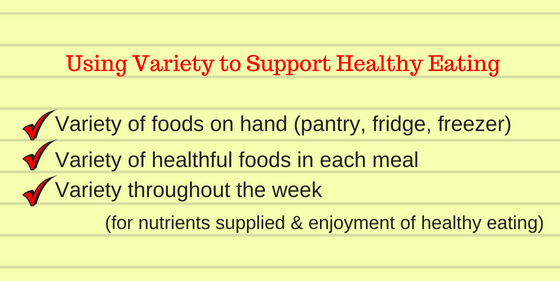
Variety itself is no assurance of a more healthful diet, and can lead to undesired weight gain by prompting us to eat more than we need. For foods you want to limit, minimizing variety in various ways can be a smart strategy. Seek the level of variety that best suits you by focusing on variety of healthful choices. This gives you a wide array of health-protectors and adds to the joy of healthy eating.
To see how variety in your choices of vegetables, fruits and other healthful foods can look over the course of a week, see Appendix 3 to the 2020-2025 Dietary Guidelines for Americans. Healthy U.S.-style, Mediterranean-style and Vegetarian dietary patterns are each illustrated, with separate charts for adults and for toddlers.
Check out my series on variety for practical tips and links to recipes and tools than can help you use variety to support good health: Variety? Why it Could be Making Healthy Eating Harder and 7 Ways Variety Can Make Healthy Eating Easier.
**de Oliveira Otto MC et al. Dietary Diversity: Implications for Obesity Prevention in Adult Populations: A Science Advisory From the American Heart Association. Circulation, 2018 Sep 11;138(11):e160-e168.
Bhupathiraju SN, et al. Quantity and variety in fruit and vegetable intake and risk of coronary heart disease. Amer Journal of Clinical Nutrition, 2013; 98(6):1514-1523.
Li W, Guo Y, Zhang C, et al. Dietary Phytochemicals and Cancer Chemoprevention: A Perspective on Oxidative Stress, Inflammation, and Epigenetics. Chem Res Toxicol. 2016 Dec 19;29(12):2071-2095.
Liu RH. Health-Promoting Components of Fruits and Vegetables in the Diet. Advances in Nutrition, 2013; 4(3):384S–392S.
Vadiveloo M, Parker H, Raynor H. Increasing low-energy-dense foods and decreasing high-energy-dense foods differently influence weight loss trial outcomes. Int J Obesity (Lond). 2018;42(3):479-486.
Vadiveloo M, et al. Dietary Variety Is Inversely Associated with Body Adiposity among US Adults Using a Novel Food Diversity Index, Journal of Nutrition, 2015; 145(3):555-563.
Vadiveloo M, et al. Greater Healthful Dietary Variety Is Associated with Greater 2-Year Changes in Weight and Adiposity in the Preventing Overweight Using Novel Dietary Strategies (POUNDS Lost) Trial. Journal of Nutrition, 2016; 146(8):1552–1559.
Vadiveloo M, et al. Associations between dietary variety and measures of body adiposity: A systematic review of epidemiological studies. British Journal of Nutrition, 2013; 109(9):1557-1572.
5 Comments
Leave a Comment
Published : August 16, 2018 | Last Updated: April 17, 2022
Tagged: Dietary diversity, dietary variety, healthy diet, healthy eating, heart health, plant-based diet, variety, variety in the diet, vegetables, weight control, weight loss
Meet the author/educator

Karen Collins
MS, RDN, CDN, FAND
I Take Nutrition Science From Daunting to Doable.™
As a registered dietitian nutritionist, one of the most frequent complaints I hear from people — including health professionals — is that they are overwhelmed by the volume of sometimes-conflicting nutrition information.
I believe that when you turn nutrition from daunting to doable, you can transform people's lives.
Accurately translating nutrition science takes training, time and practice. Dietitians have the essential training and knowledge, but there’s only so much time in a day. I delight in helping them conquer “nutrition overwhelm” so they can feel capable and confident as they help others thrive.
I'm a speaker, writer, and nutrition consultant ... and I welcome you to share or comment on posts as part of this community!

[…] You may have heard in the news that diet variety isn’t such a good thing after all. Dietitian Karen Collins helps explains what those headlines about diet variety actually mean. […]
[…] You could have heard that food plan was not a so good in spite of everything. Dietitian Karen Collins helps to know what these titles imply about food plan selection. […]
Really cool article, friend!
You are what you eat
[…] Nutritionist Karen Collins says, […]
[…] doesn’t only add a great range of nutrients, variety helps to keep healthy eating habits interesting. For example, at one time the only pulses I was […]